What goes in which bin: a UK recycling guide
You'd think this would be simple. You have bins. You have rubbish. Put the right things in the right bin. But the UK has over 360 local authorities, each running their own collection scheme with their own bin colours, their own rules, and their own ideas about what counts as recyclable.
The result is that a blue bin in Manchester means something completely different to a blue bin in Bristol. A green bin might be for recycling, garden waste, or general rubbish depending on which side of a borough boundary you live on. And nobody prints this stuff on the bin itself.
This guide covers the most common bin types across the UK, what generally goes in each one, the items that trip people up, and where to check when you're not sure.
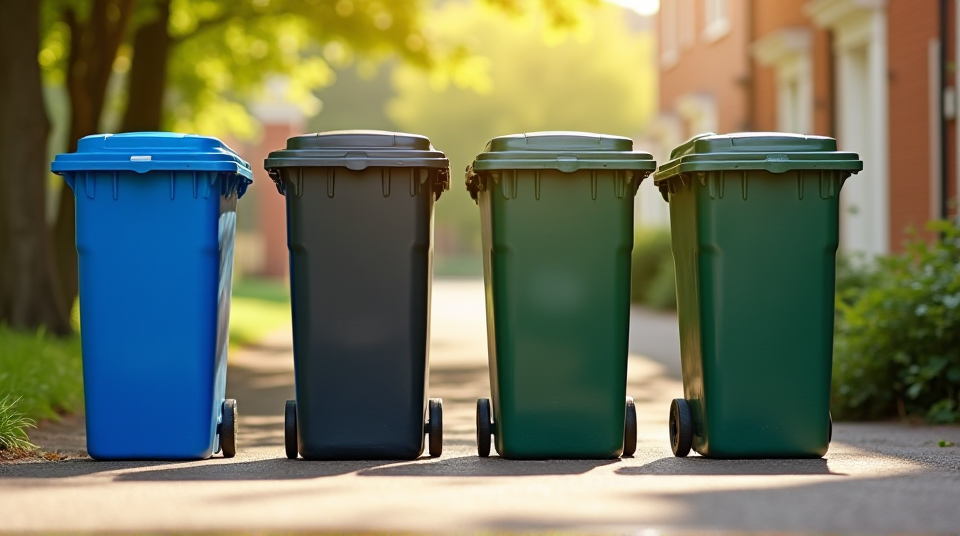
The standard bins (sort of)
There is no national standard for bin colours. That feels like it should be the headline, but it's just the reality. The colours below are the most common assignments across England, but your council may do things differently. Scotland and Wales often use their own colour schemes entirely.
| Bin type | Common colour(s) | What goes in |
|---|---|---|
| General waste | Black or grey | Non-recyclable household waste. Nappies, broken crockery, polystyrene, contaminated packaging, cat litter, vacuum cleaner dust. |
| Dry recycling (mixed) | Blue or green | Paper, cardboard, tins, cans, plastic bottles, plastic tubs, glass bottles and jars (in some areas). Items should be clean, dry and loose. |
| Paper and cardboard | Blue or brown | Newspapers, magazines, envelopes, cardboard boxes (flattened), cereal boxes. Some councils collect this separately from other recyclables. |
| Garden waste | Green or brown | Grass clippings, hedge trimmings, leaves, weeds, small branches. Usually a paid subscription (£40-60/year). |
| Food waste | Small green or brown caddy | All food scraps including cooked food, meat, bones, tea bags, coffee grounds, dairy. Use the kitchen caddy with a liner, empty into the outdoor caddy. |
| Glass | Green box or included in mixed recycling | Glass bottles and jars. Some councils collect glass in a separate box; others accept it in the main recycling bin. Lids go in the recycling bin, not the glass box. |
The colour chaos
Liverpool uses purple bins for general waste. The Mancunian Matters website reported in 2019 that Greater Manchester alone uses ten different bin colours across its councils. In Tameside, green means general waste. Cross the borough boundary into Manchester and green means garden waste or food recycling.
North Ayrshire in Scotland uses purple for recyclables (glass, plastics, cans, cartons), which is exactly the opposite of Liverpool's purple. Some London boroughs use grey for general waste where most of England uses black.
This is not a quirk that's going to be fixed any time soon. Simpler Recycling (the DEFRA reform that took effect in March 2026) standardises which materials councils must collect, but says nothing about which colours they use. Replacing hundreds of thousands of bins to match a hypothetical national colour scheme would cost millions per council, and no government has mandated it. More on Simpler Recycling in our separate article.
Items people always get wrong
These are the things I see asked about constantly. Some of the answers are genuinely confusing because they've changed over time, or because your council might have different rules to the one next door.
1. Pizza boxes
The greasy base of a pizza box cannot be recycled. Grease contaminates the paper fibres and the entire batch gets rejected. But the clean lid and sides can usually go in the recycling. Tear the box in half: clean part in recycling, greasy part in general waste.
This one confuses people because the box is made of cardboard, and cardboard is recyclable. The material is fine. It's the grease that's the problem.
2. Tetra Paks and cartons
Juice cartons, milk cartons, soup cartons. For years, most councils didn't accept them because they're made of layers of card, plastic and aluminium bonded together. Separating those layers needs specialist equipment.
The good news: from March 2026, Tetra Paks and cartons are included in the standard recyclable materials list under Simpler Recycling. Most councils now accept them in the dry recycling bin. Rinse them, flatten them, put them in. But a handful of councils still don't have the processing infrastructure, so check locally if you're not sure. RecycleNow's postcode locator will tell you what your specific council accepts.
3. Soft plastics
Crisp packets. Cling film. Bread bags. Salad bags. Bubble wrap. As of May 2026, these are not accepted in standard kerbside recycling bins. That is almost certainly going to surprise people who've been chucking them in their blue bin for years.
Right now, the only option is supermarket collection points. Most large Tesco, Sainsbury's and Co-op stores have soft plastic collection bins near the entrance. Plastic film and bags will be added to kerbside collection from 31 March 2027 under the next phase of Simpler Recycling.
4. Black plastic trays
Ready meal trays, meat trays, mushroom punnets in black plastic. The problem was that optical sorting machines in recycling plants use near-infrared sensors, and carbon-black pigment absorbs the light. The machines literally can't see black plastic, so it gets sent to landfill.
Most manufacturers have switched to detectable pigments or clear plastic over the last few years, but many councils still explicitly exclude black plastic trays from kerbside collections. The situation is genuinely improving but inconsistent. If your council says no to black plastic, trust them over what the packaging says.
5. Carrier bags in the recycling bin
Never use a plastic bag to hold your recycling. Put items loose in the bin. A single bag can clog the sorting machinery and contaminate a lorry-load. This is probably the most common mistake and the one that causes the most damage at the processing end.
6. Nappies
Always general waste. No exceptions. They are one of the most common contaminants found in recycling bins, according to multiple council contamination reports. If in doubt: if it's been in contact with human waste, it goes in the black bin.
7. Polystyrene
Takeaway containers, packaging foam, those white chips that come in electronics boxes. None of it goes in kerbside recycling. General waste. Expanded polystyrene is technically recyclable at specialist facilities, but your council bin round is not one of them.
8. Drinking glasses, Pyrex and ceramics
This catches people out because glass bottles go in recycling, so glass must be recyclable, right? Drinking glasses, Pyrex, oven dishes, ceramic mugs and plates have different melting points to bottle glass. They contaminate the glass recycling process. A single Pyrex dish can ruin an entire batch of glass cullet.
These go in general waste, or take them to your Household Waste Recycling Centre if you have a large amount.
The "when in doubt, bin it" problem
There's a tempting instinct when you're not sure about an item: chuck it in the recycling and hope for the best. This is called "wish-cycling" and it makes things worse, not better.
A single contaminated bin can cause an entire lorry-load of recycling to be rejected and sent to landfill. That's the recycling from your entire street, ruined because of one wrong item.
Canterbury Council and Waltham Forest Council both publish data on recycling bin contamination. The main contaminants are nappies, food-soiled packaging, plastic bags, and items people hoped were recyclable but weren't.
If you're genuinely not sure whether something is recyclable, it is better to put it in general waste than to contaminate the recycling. Your council's contamination rate goes down, the recycling your neighbours put out actually gets recycled, and the sorting facility doesn't have to deal with a nappy in the cardboard stream.
England's household recycling rate sits at roughly 44%. Simpler Recycling aims to push that higher. Contamination is one of the biggest barriers to improving it.
Regional variations worth knowing about
| Colour | What it means (varies) | Where |
|---|---|---|
| Black | General waste (most common) | Majority of English councils |
| Grey | General waste or dry recycling | Parts of London, some southern councils |
| Blue | Dry recycling (paper, cans, plastic) | Common across England |
| Green | Garden waste, or recycling, or general waste | The most inconsistent colour nationally |
| Brown | Garden waste, or food waste, or paper/card | Varies widely |
| Purple | General waste (Liverpool), recyclables (North Ayrshire) | Regional outliers |
Green is the worst offender. It means recycling in some boroughs, garden waste in others, and general waste in a handful of places. If you've just moved house, do not assume your new green bin does the same thing as your old one.
How to check what your council accepts
The single most useful resource is WRAP's RecycleNow Recycling Locator. Type your postcode and it tells you exactly what your council accepts in each bin. WRAP reported it was used over 7.5 million times in 2022. It is the closest thing to a universal reference the UK has.
Your council's own website will have the definitive rules, though finding the right page can be an adventure in itself. Every council structures their website differently, and "bins and recycling" might be under Environment, Waste, Housing, or a completely different section. GOV.UK has a postcode lookup tool that redirects you to the right council page, which saves the navigation headache.
What Binformation shows you
Binformation pulls your specific bin types from your council's data. If your area has general waste, mixed recycling, garden waste and food caddies, those are the bins you see in the app. If your council only collects two types, you see two types. The app doesn't guess or assume anything about colours or categories. It shows whatever your council reports.
That won't help you figure out whether a pizza box goes in the recycling, but it does mean you'll always know which bins are being collected tomorrow. For the detailed "what goes where" rules, your council's website or the RecycleNow locator are still the best sources.
 Get Binformation — Free on Google Play