Why UK councils all use different bin colours
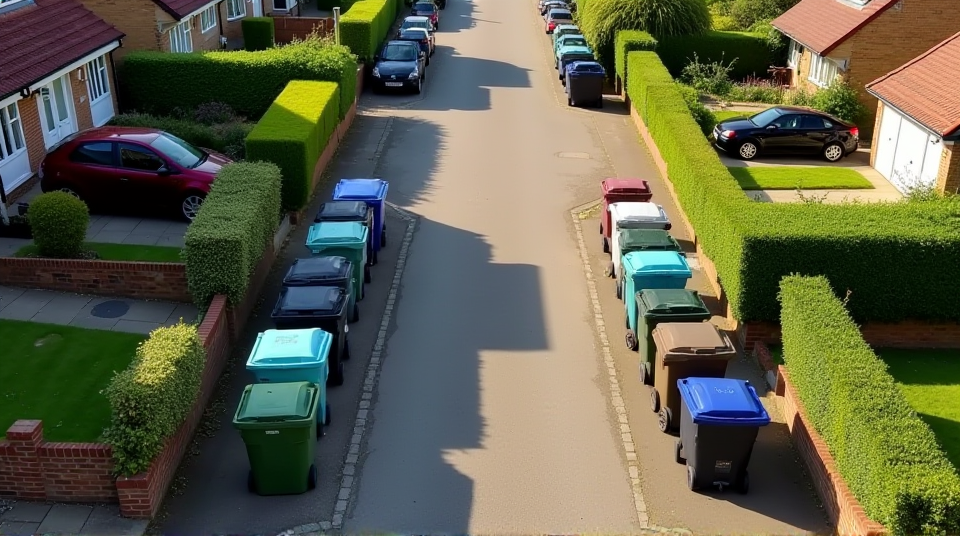
If you've ever moved house and discovered that the green bin at your new address means something completely different to the green bin at your old one, you're experiencing the consequence of a decision that was never made. Nobody in government ever decided what colour bins should be. They just let everyone pick their own.
Here's how that happened.
A brief history of the wheelie bin
Before wheelie bins, the UK had metal dustbins. Heavy, loud, no wheels. The dustman physically lifted them onto his shoulder and carried them to the lorry. Back injuries were rampant.
In 1968, Frank Rotherham Mouldings in Slough invented the first plastic wheelie bin. It wasn't designed for household waste collection at all. It was meant for moving waste around inside factories. But the idea spread.
The first council to use wheelie bins for household collection was Broxtowe Borough Council in Nottinghamshire, in 1983. They chose them because they were lighter, could be picked up mechanically, and held more than the old metal bins.
Through the late 1980s, refuse lorries were fitted with hydraulic lifting mechanisms. This made wheelie bins practical at scale: the bin slots onto the lifter, the arm tips it into the lorry, nobody lifts anything. By the early 1990s, wheelie bins were spreading rapidly across the country.
The Manual Handling Operations Regulations of 1992 accelerated the switch further. Heavy metal dustbins were a health and safety liability for refuse workers. Plastic wheelie bins with wheels and mechanical collection solved that.
Then came recycling
For the first couple of decades, most households had one bin. General waste. Everything went in together.
The 2003 Household Waste Recycling Act changed that. It required every council to offer separate collection of at least two recyclable materials by 2010. Suddenly every council needed more bins. A second bin for recycling. A third for garden waste. A food caddy. Maybe a glass box.
Each council procured these bins independently. They went out to tender, picked a manufacturer, chose colours based on what was available, what was cheapest, or what someone in the waste team thought was a good idea. There was no coordination between councils. No government guidance on colour. Just hundreds of independent purchasing decisions spread over a decade.
The Environmental Protection Act 1990 had already established a duty of care for waste management. But it set rules about how waste should be handled, not what colour the containers should be. The act created the legal framework for council waste services. It did not include a line item for bin aesthetics.
Why no national standard exists
There are several reasons, and they compound each other.
Local authority autonomy. Waste collection is a devolved responsibility. Councils are not arms of central government. They run their own services, set their own budgets, and make their own procurement decisions. DEFRA can mandate what materials are collected (as Simpler Recycling does), but mandating what colour the bin is would be a level of interference that has never been politically attempted.
The European Standard BS EN 840. This is the standard that governs wheelie bins in the UK. It standardises dimensions, structural strength, wheel specifications, and lifting mechanisms. A bin built to BS EN 840 will fit on any compatible refuse lorry. But the standard says absolutely nothing about colour. It ensures bins are interoperable mechanically. Aesthetics are not its concern.
Procurement timing. Councils adopted wheelie bins at different points between 1983 and 2010. A council that rolled out bins in 1995 chose from whatever their preferred manufacturer offered at the time. A council that started in 2007 made a completely separate choice from a potentially different manufacturer. Once a colour is deployed to hundreds of thousands of households, it becomes the de facto standard for that area.
The cost of change. Replacing every bin in a council area to match a hypothetical national colour scheme would cost millions. A single 240-litre wheelie bin costs £15-25. Multiply by the number of households, multiply again by two or three bins per household, and you're looking at a bill nobody wants to pay for what is essentially a cosmetic change.
The colour table
| Colour | Used for | Notes |
|---|---|---|
| Black | General waste (most common nationally) | The default for most English councils |
| Grey | General waste or dry recycling | Parts of London and some southern councils |
| Blue | Dry recycling | The closest thing to a consistent colour across England |
| Green | Garden waste, or recycling, or general waste | The most inconsistent colour. Means different things in adjacent boroughs. |
| Brown | Garden waste or food waste or paper/card | Varies by region |
| Purple | General waste (Liverpool) or recyclables (North Ayrshire) | Opposite meanings in different places |
| Red | Specific materials (glass, batteries) | Uncommon, usually a box not a wheeled bin |
Liverpool's purple bins are probably the most famous outlier. The colour reportedly represents both football clubs in a city that refuses to pick between them. Whether that's apocryphal or genuine council reasoning, I've never been able to verify. But the bins are definitely purple.
Greater Manchester is the most chaotic region. The Mancunian Matters news site counted ten different bin colours in use across the metropolitan area's councils. Green means general waste in Tameside. Walk across the boundary into Manchester and green means food or garden recycling. Blue means recycling in some boroughs and doesn't exist in others.
Will Simpler Recycling fix this?
No. Simpler Recycling (which took effect 31 March 2026 for households) standardises which materials councils must collect. It does not standardise bin colours. DEFRA has not proposed colour standardisation, and there is no indication they plan to.
Over time, as councils replace ageing bin stock, there may be a natural drift toward more consistency. If every council collects the same four waste streams, it becomes easier for manufacturers to offer "standard" colour sets. But that's a slow, organic process driven by procurement cycles, not a mandate.
For now, the only way to know what your bins mean is to check with your council. Or use an app like Binformation that pulls your specific bin types from your council's data, so you see exactly what's being collected and when, regardless of what colour the bin happens to be.
 Get Binformation — Free on Google Play